Home > Photojournalism > Stories > Horthy
 

Burying
Hungary's
Past

Kenderes, Hungary
September 4, 1993


Copyright © 1993 by Kamenko Pajic, All Rights Reserved

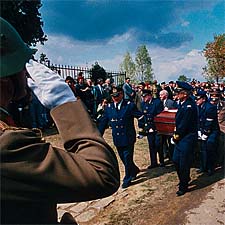
Re-enactors in Naval uniform carry the coffin of Miklós Horthy, Austro-Hungarian admiral and long-time Hungarian ruler

In September 1993, controversy erupted in Hungary over the repatriation of the remains of Miklós Horthy, a Hungarian admiral and conservative leader who defeated revolutionary forces in Hungary after World War I and remained the country's head of state until 1944. The reburial was arranged by a few small right wing parties and organisations.

A member of a noble Protestant family, Horthy entered the Austro-Hungarian naval academy at Fiume (now in Croatia) at age 14. Aide-de-camp to the emperor Francis Joseph (1909-14), he distinguished himself as a naval commander in World War I by several times breaking the Allied Adriatic blockade. Promoted to admiral in 1918, he presided over the Austro-Hungarian fleet's transfer to Yugoslavia in October 1918.

The following year, at the request of the counter-revolutionary government at Szeged, Hungary, Horthy organized an army to oppose the Communist regime of Béla Kun and led his troops into the capital in November after Kun had fled. The Hungarian Parliament, elected in January 1920, declared for the restoration of the monarchy and elected Horthy regent (March 1). Horthy, however, despite much controversy, thwarted the efforts of King Charles IV to recover his throne.

From 1921 to 1931 Horthy had little to do with public affairs, leaving the conduct of government in the hands of Count István Bethlen. During the troubled 1930s, however, Horthy assumed more and more control, and in 1937 the Parliament voted a considerable extension of his powers. Although he disliked Adolf Hitler, he sympathized with the German dictator's "crusade against Bolshevism," and initially acquiesced in Hungary's adherence to the German side in World War II. His later efforts to extricate Hungary from the war led to his forced abdication and abduction by the Germans in 1944. He was released by Allied troops in May 1945 and allowed to go to Portugal.

He died on Februray 9, 1957 in Estoril, Portugal.

Copyright © 1993 by Kamenko Pajic, All Rights Reserved

Copyright © 1993 by Kamenko Pajic, All Rights Reserved

Click on pictures to see them enlarged

Copyright © 1993 by Kamenko Pajic, All Rights Reserved Copyright © 1993 by Kamenko Pajic, All Rights Reserved Copyright © 1993 by Kamenko Pajic, All Rights Reserved


© Copyright 2003 by Kamenko Pajic. All rights reserved.

The images presented in this website may not be reproduced, copied, projected, used or altered in any way,
alone or with any other image(s), by use of computer or other electronic means, without specific permission.